
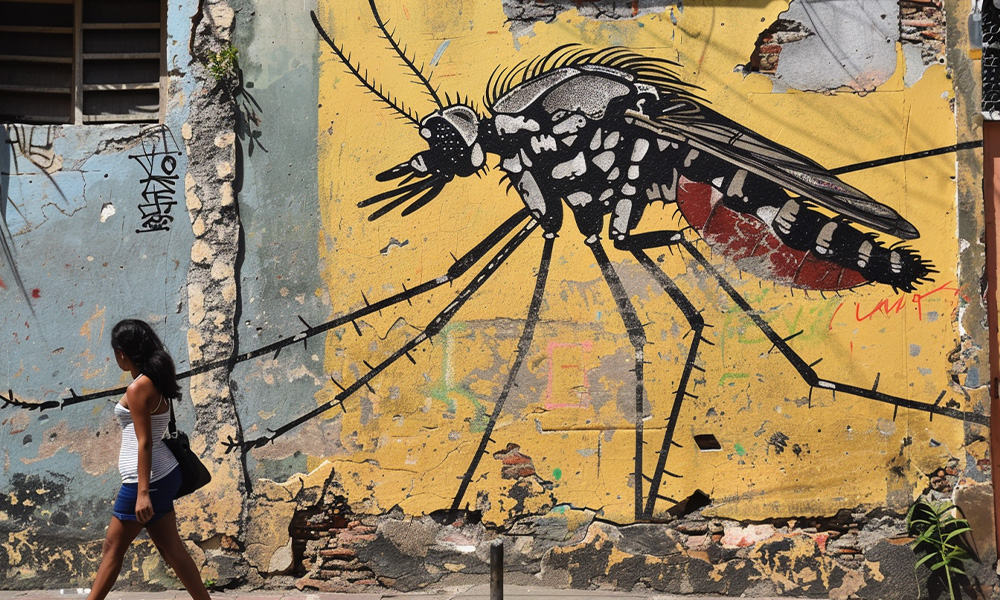
With 3.5 million cases so far this year, Latin America and the Caribbean will likely experience their “worst dengue season,” fueled by the combination of the El Niño phenomenon and climate change, PAHO warned on Thursday.
This disease, which causes fever, headache and pain behind the eyes, muscle and joint discomfort, is transmitted through the bite of an infected mosquito, the Aedes aegypti.
As of March 26, “the Americas recorded more than 3.5 million cases of dengue, including more than 1,000 deaths,” said Jarbas Barbosa, director of the Pan American Health Organization (PAHO), at a press conference.
It is a “cause for concern since it represents three times more cases than those reported for this same date in 2023, a record year with more than 4.5 million cases reported in the region,” he added. So “this will probably be the worst dengue season ever in the Americas,” he warned.
Southern Cone
The increase is observed in all countries of Latin America and the Caribbean but especially in three of the Southern Cone: Brazil (81%), followed by Paraguay (6%) and Argentina (3.4%), which account for 92% of all cases and 87% of deaths.
This is because dengue follows a seasonal pattern and most of the transmission in the southern hemisphere occurs in the first half of the year, during the warmer and rainier months.
What is striking is that in other countries where “high transmission is expected in the second half of the year,” such as Costa Rica, Guatemala or Mexico, “we are also currently seeing an increase in cases,” warned the PAHO director. And the presence of the vector mosquito is observed in areas where it was not known, such as in Uruguay.
There are four dengue serotypes and the simultaneous circulation of two or more can increase the risk of epidemics and their severe forms.
To date, 21 countries in the Americas have reported the circulation of more than one serotype, PAHO notes. “Environmental causes play a key role,” according to Barbosa.
“Rising temperatures and more frequent extreme weather events such as heat waves, intense droughts that lead to inadequate water storage by the population, and storms and floods can increase the proliferation of the vector mosquito,” he explains.
“The combination of the El Niño phenomenon with climate change puts at risk all large cities that are in tropical and subtropical areas of the region,” he adds, because the vector mosquito can proliferate “very quickly” in those areas.
Breeding sites “in homes”
Social factors also affect, with rapid population growth, unplanned urbanization, precarious housing, insufficient sanitation and inadequate waste disposal.
The best way to control transmission is to eliminate mosquito breeding sites, both in private homes and in public places such as parks, businesses or plazas. Because “around 80% of mosquito breeding sites are in people’s homes or nearby,” in objects that store water, Barbosa says.
This is much more effective at this time, according to him, than vaccines or new technologies such as the use of a bacterium, Wolbachia, “which can prevent the mosquito from becoming infected by the virus.”
“The vaccine we have available is not going to curb the dengue epidemic” because “it has a limited scope,” said Dr. Daniel Salas, executive manager of PAHO’s special program for comprehensive immunization, at the press conference.
This vaccine, recommended from 6 to 16 years old, is two doses administered three months apart and studies show, according to PAHO, that eight years of vaccination are needed to have a significant impact on transmission.
For its part, the bacterium “is a potential new weapon for the future” but at the moment it is in a pilot study phase, said Dr. Sylvain Aldighieri, director of the department of forecasting, control and elimination of communicable diseases at PAHO.