

Despite the best efforts of many a telescope-wielding nature guide, I fell in love with birds while sitting at my desk in San José, editing a field guide to the birds of Costa Rica in my previous job. As it turns out, birding is the nature-lover’s antidote to living in the city, because birds are everywhere. And the ones you see while sitting in traffic are no less amazing than those deep in the rain forest.
So, if you find yourself in a jungle of the concrete variety, here’s a quick introduction to some of the most common birds of San José (and many other urban areas of Costa Rica).
1. Great Kiskadee (Pitangus sulphuratus)
Spanish & Costa Rican local names: Bienteveo Grande, Cristo Fue, Pecho Amarillo*

The great kiskadee is a raucous bird whose name is derived from its call in both English (“KIS-ka-DEE”) and Spanish (“bien-te-veo”). Here’s what a group of great kiskadees sounds like:
Great kiskadees are common in gardens and open areas throughout the country; in San José they perch in trees and on utility wires, and make an enormous amount of noise. They belong to the tyrant flycatcher family (Tyrannidae).
2. Clay-colored Thrush (Turdus grayi)
Spanish & Costa Rican local names: Mirlo Pardo, Yigüirro

This drab species (formerly known as clay-colored robin) doesn’t seem like the obvious choice for Costa Rica’s national bird, but it was chosen for its song, not its looks. According to local lore, the Yigüirro “calls the rain” just before the rainy season, with its long, wandering song:
The clay-colored thrush is often seen hopping on the ground, as it forages actively for invertebrates. It belongs to the Turdidae family, which includes thrushes, robins, solitaires, and others.
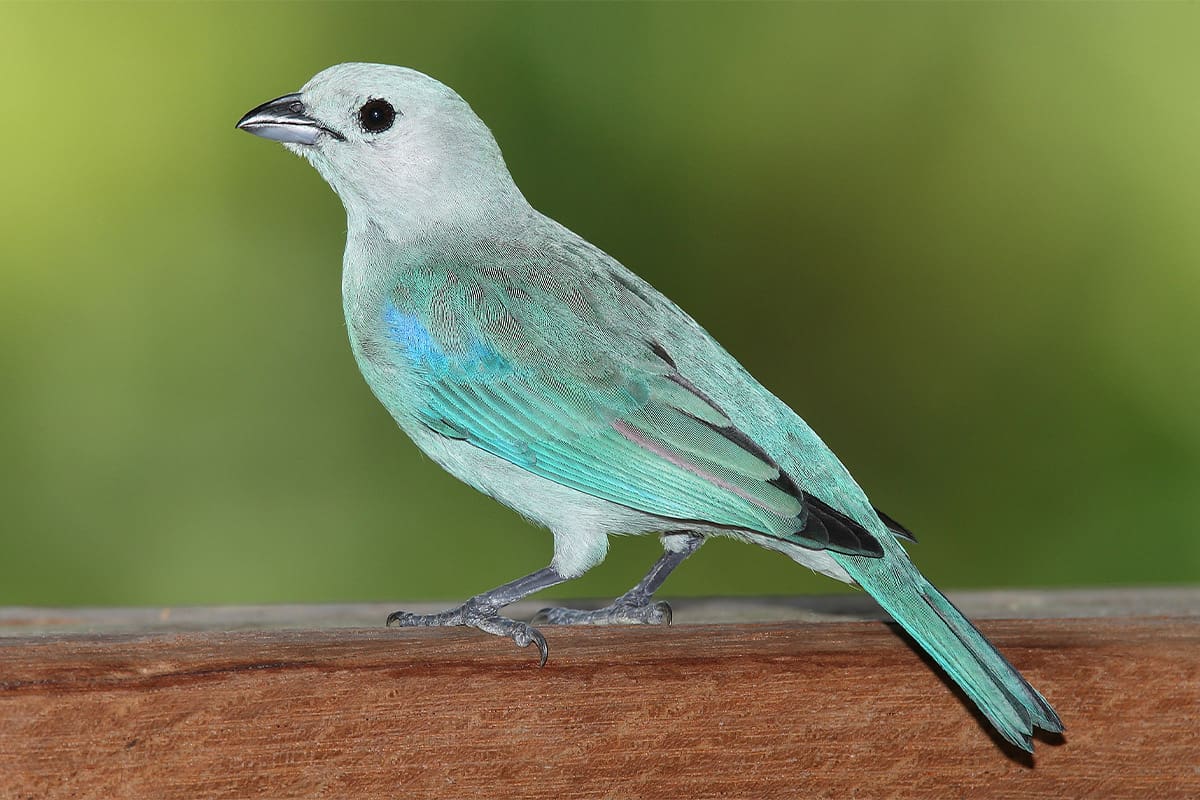
3. Blue-gray Tanager (Thraupus episcopus)
Spanish & Costa Rican local names: Tangara Azuleja, Viudita, Viuda

Tanagers are among the most colorful birds in the neotropics, and this species is no exception. Blue-gray tanagers prefer open and semi-open areas, and are commonly found along roads and in urban parks and gardens. They are monogamous, and typically travel in pairs (sometimes forming small flocks) year-round. They eat berries and other fruits and also forage for arthropods. They belong to the Thraupidae family.
4. Great-tailed Grackle (Quiscalus mexicanus)
Spanish & Costa Rican local names: Clarinero, Zanate Grande, Sanate

Few birds can match the attitude of the great-tailed grackle, which can be seen strutting around parks and plazas throughout Costa Rica, flashing its piercing yellow eyes and trailing a giant V-shaped tail. Grackles are highly intelligent (many have been observed stealing dog food and soaking it in water to soften it), and are considered pests in some parts of the world where their populations have expanded rapidly. Grackles belong to the Icteridae family, along with orioles and blackbirds. They produce a variety of bizarre sounds:
5. Inca Dove (Columbina inca)
Spanish & Costa Rican local names: Tortolita Colilarga, San Juan, Tórtola

These tiny doves can often be seen walking on the ground in pairs or small groups, foraging for seeds. As if their mutual preening weren’t cute enough (see video), they also engage in “pyramid roosting,” wherein as many as 12 birds will pile up 3 layers high to sleep. Inca doves belong to the Columbidae family, along with pigeons.
* All Spanish and local species names are taken from the Asociación Ornitológica de Costa Rica.
Check out other “Into the Wild” columns here.
Written by Robin Kazmier in 2015 and is author of National Parks of Costa Rica (with photographer Greg Basco).





