
Lazaro Yat looked on helplessly as his 17-year-old son left the family home in Guatemala and embarked on the perilous journey to the United States as an undocumented migrant.
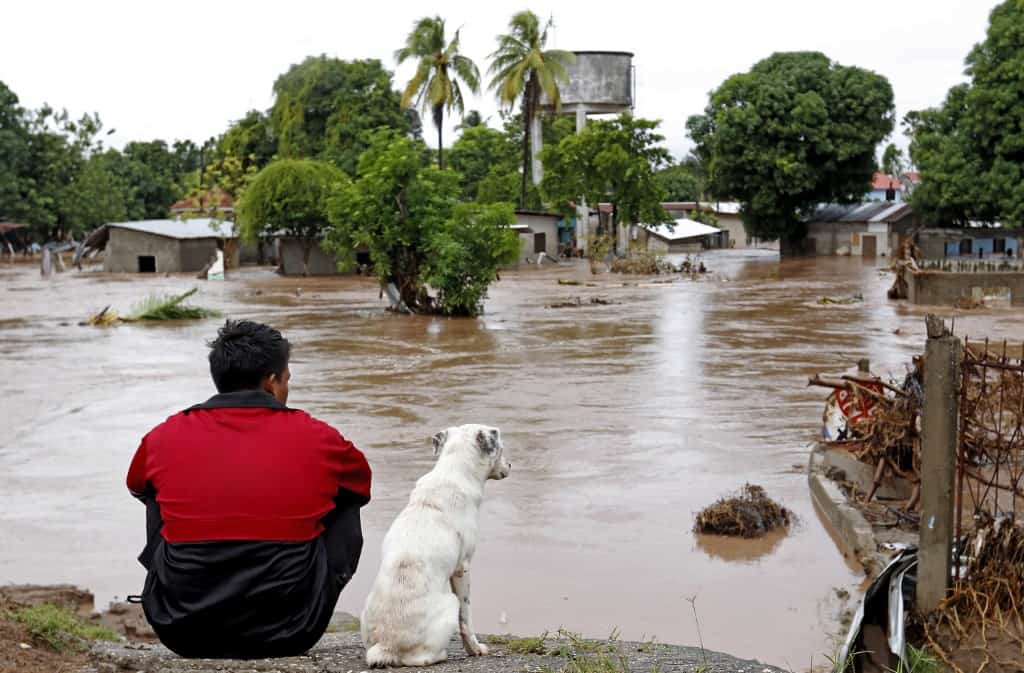
Two powerful hurricanes that struck the north of the Central American country in 2020 decimated cardamom crops, leaving thousands of indigenous people destitute.
“Everyone suffered because their crops were left submerged in water,” Yat told AFP from Cerro Azul, a tiny village of barely 500 people at the foot of the mountains in Quiche department.
Hurricanes Eta and Iota ripped through this region in October and November 2020 leaving 200 people dead and massive damage throughout Central America.
Experts say climate change is contributing to ever more devastating weather episodes.
A year ago the banks of the Azul river that runs along the village broke and flooded streets, homes, fields and pastures.
The vast green fields of cardamom were submerged for four months and when the waters receded, they left behind rotting vegetation and sterile soil.
The ground will recover, says Yat, a 42-year-old member of the Mayan Q’eqchi people, but cardamom takes three to four years to bear fruit.
He now survives by growing corn on hills that remained above the flood waters.
‘Nothing left’
Oscar, Yat’s eldest of four sons who used to help him in the fields, was one of many young people who could not wait and instead set off on the 120-kilometer trek to the Mexican border, hoping to continue on to the United States.
“Some people went northwards (towards the US) because there was no way of surviving here,” said Yat.
Oscar “went for the same reason: we have nothing left. We didn’t want to send him but he decided to go … And we couldn’t do anything.”
The teenager left in February on a dangerous journey in which many migrants are murdered, kidnapped, tortured or exploited.
Two months later he managed to cross the Mexican border. Now 18, he works in a baker’s in Massachusetts.
But he sends home “very little” money because he is still paying off the people-trafficker — known as a coyote — that helped him get to the United States.
Two of Oscar’s teenage cousins also left.
They are among more than a million Central Americans displaced by the impact of Eta and Iota, according to a study by the International Organization for Migration.
For Alex Guerra, director of Guatemala’s institute of investigation on climate change, such natural disasters provoked by global warming are a growing “trigger” for migration in the region.
Thousands of Guatemalans, Hondurans and El Salvadorans try every year to reach the United States illegally.
They are fleeing poverty and violence, and extreme weather events can “provide the last push that makes people decide to migrate,” Guerra told AFP.
In September, the World Bank said climate change could prompt 216 million people to migrate by 2050, including 17 million in Latin America.
‘We’re already scared’
Cerro Azul residents say they never before had flooding like that provoked by Eta and Iota.
They were part of “the most active” Atlantic cyclone season in history, according to the UN Economic Commission for Latin America and the Caribbean.
Of the 30 tropical storms in 2020, 13 were hurricanes, the study said.
Central America is particularly vulnerable to climate change given its location in a cyclone zone, as well as being home to earthquakes, active volcanoes and affected by the El Nino and La Nina phenomenon.
The problems are exacerbated by massive social inequality, poor planning and weak infrastructure.
“There are places where there is flooding more regularly than before, year after year. We have years where there is flooding and drought, sometimes in the same places,” said Guerra.
The wooden huts with zinc roofs of Cerro Azul, a remote village accessed only by 325 kilometers of dangerous roads and dirt tracks, provide a poor defense against the elements.
“Whenever it rains hard we’re on alert to see what’s coming because we’re already scared,” said Sonia Choc, dressed in a typically colorful Guatemalan outfit.
Since her cardamom crops were destroyed, she has been growing vegetables and rearing chickens. Others from the village have left to find work as laborers.
Yat has reached the end of his tether and is on the verge of joining the exodus.
“I think next year, or this year, I’m leaving. I have nothing left here, I can’t do any more,” he said.