
Costa Rica is famous for its biodiversity. There’s an incredible amount of life packed into this tiny country. However, this diversity of species isn’t uniformly present throughout the nation. Many factors, including habitat type and the impact of human beings, affect the presence of a certain species present in a given area.
I’ve spent the last 8 years or so using camera traps to sample the level of species diversity around the country, but I’ve mostly focused on a specific part of the country, Guanacaste. After many camera revisions from locations throughout Guanacaste, I’ve come up with an informal gradient of species diversity that’s based on the animals that my cameras are best at recording, mammals.
Areas with the very highest levels of species diversity are still home to Costa Rica’s largest mammals, the white-lipped peccary, the jaguar, and Baird’s tapir. As the level of species diversity begins to drop, the white-lipped peccaries are the first to disappear, followed by the jaguars and tapirs. In my experience, the first primate species to disappear when dropping down a level of diversity are Central American spider monkeys.
These levels of diversity are nothing official, just patterns I’ve noticed while carrying out camera trap projects throughout Guanacaste. At this point, when I begin a new project, I have a pretty solid idea of what species are going to be missing from the environment based on results from work I’ve done in that general area.
This year, when I had the opportunity to work with a coalition of organizations including the Fondo de Biodiversidad Sostenible and FONAFIFO on a wildlife monitoring project in the Nicoya Peninsula, I thought I knew what species were going to present on the properties. The project is still ongoing, but my assumptions were proven incorrect during the revision of the very first camera.
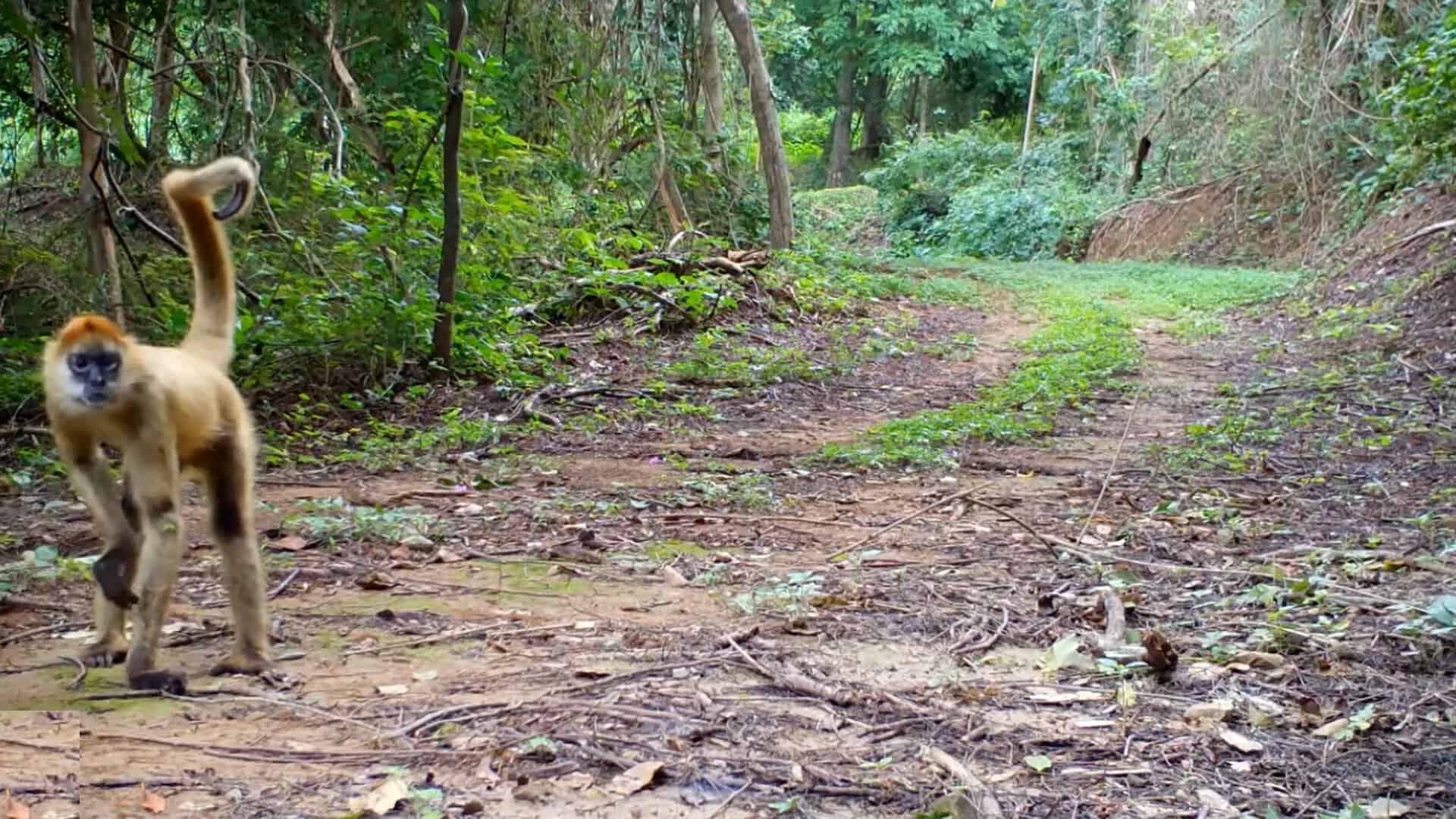
As I scrolled through species that I knew were going to be present, agoutis, ocelots, nine-banded armadillos, one video stopped me in tracks. It featured two Central American spider monkeys fleeing from the ground up into the trees, either frightened by the presence of my camera or something else nearby.
I was shocked. The nearest property where I had recorded or seen spider monkeys was in northern Guanacaste some 100 kilometers from the place I was sitting. On top of that, I had done some internet sleuthing in the past about locally extinct species on the peninsula and had read that spider monkeys were amongst the species, like jaguars and Baird’s tapirs, that had disappeared decades ago.
Obviously delighted to be wrong, I did some more research when I got home and found that Rescate Wildlife Rescue Center (formerly Zoo Ave) had a reintroduction program that had done some work in the Nicoya Peninsula and one of the species that they had focused on was spider monkeys. Excited about learning more, I reached out to Rescate Program Director Amy van Esch to tell her about my camera trap video and learn more about the program. Amy confirmed that they had been working on wildlife reintroductions for years and even offered to share some more information about their work. Here’s what she had to say –
“Rescate Wildlife has been working in the Nicoya region for over 35 years. Within the foundation we have a large protected area of over 800 hectares (about 2,000 acres) that we use as a release site for many different species.The spider monkey was completely extinct in this region at that time.
In the year 2000 we released a group of 44 spider monkeys, 31 former pets (who came to our rescue center through the pet trade), and 13 born onsite through our endangered species breeding program. Fast forward 26 years and we now have various wild troops with over 100 individuals! It’s pretty amazing to think, this population has all come out of animals that were formerly pets, now living wild, reproducing and dispersing into other areas.
This last year we also started something completely new: we built one of the world’s largest pre-release enclosures, over 4 hectares in size. We currently have a troop of 12 individuals preparing for release (all former pets, some even arriving dressed in baby clothes). This will be the first time we release new spider monkeys in over 15 years.
This enclosure is unique in its size, which is full of large growth trees, allowing them to learn “to fly” between trees and gain real agility before being released into the wild. It’s something we are really looking forward to in the coming year: finally seeing them fully wild!“
How cool is that? Check out the ten second video below that proves that all of their hard work has resulted in spider monkeys once again living wild on the Nicoya Peninsula.
About the Author
Vincent Losasso, founder of Guanacaste Wildlife Monitoring, is a biologist who works with camera traps throughout Costa Rica.