
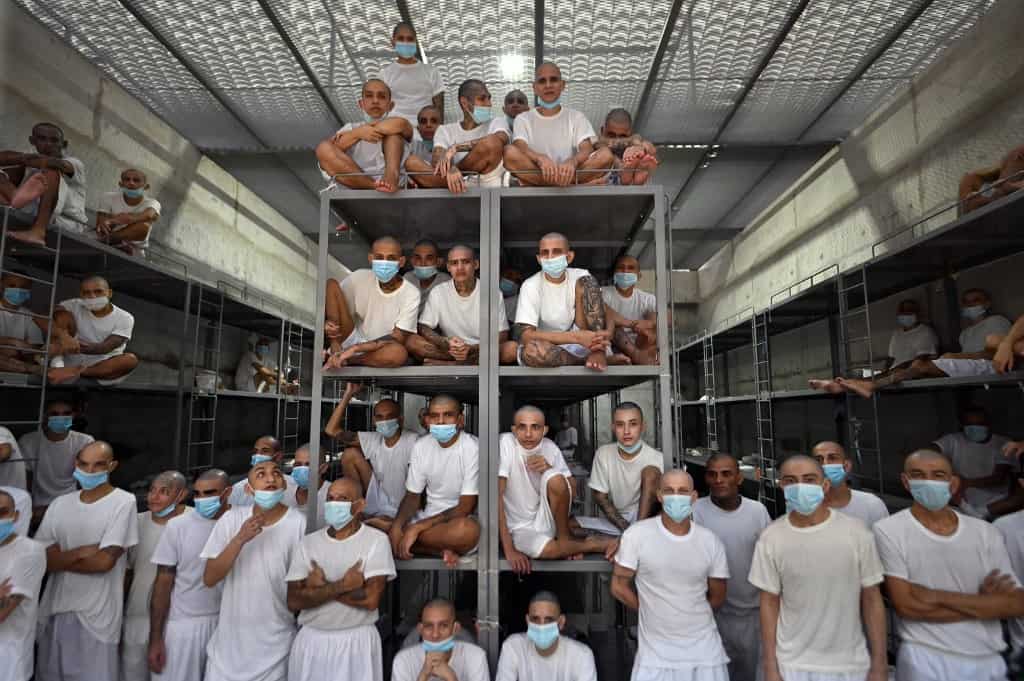
Two years after declaring war on street gangs, President Nayib Bukele now hails El Salvador as the “safest” country on the continent, but critics say that the price has been high.
What happened to the gangs?
The deployment of the military and police dealt a heavy blow to the structures of the gangs, which were financed by extortion, contract killings and drug dealing, backed by threats of death.
The InSight Crime think tank estimated that there were almost 120,000 gang members, including 78,000 belonging to Mara Salvatrucha (MS-13) and about 41,000 to Barrio 18.
More than 78,000 suspected members have been arrested, the government said Tuesday, and the gangs have been unable to recruit new members. Authorities have confiscated almost 4,000 weapons and legal reforms brought tougher penalties.
Bukele, who was reelected in February for another five-year term, has promised to continue the war “until we eradicate the little that still remains of the gangs.”
What happened in the streets?
Bukele’s campaign ended the dominance that the gangs had over 80 percent of the country, according to the government. The country’s homicide rate — which reached 106 per 100,000 inhabitants in 2015 — dropped to 2.4 in 2023, below the world average, which stands at eight according to the United Nations.
People are no longer afraid to go out at night, children play in the parks and anyone can ride a bus or visit another neighborhood without fearing for their life.
“Now you feel more confident when traveling on buses. You no longer see gang members asking passengers for money,” said Mauricio Lopez, a 40-year-old teacher. Entire communities “returned to normal lives,” said academic Carlos Carcach.
What was the economic impact?
A large part of the manufacturing, commercial and transportation sectors no longer has to pay the gangs because of extortion, according to business associations. Restaurants stay open at night and deliver food to homes. “Today there is calm. We no longer have extortion. The danger has passed,” said Aminta Alvarenga, who owns a wholesale store.
The government has seized 8,000 vehicles, almost 21,000 cell phones, as well as hundreds of buses, taxis, houses and commercial premises that were in the hands of the gangs.
A tourism boom generated income of nearly 2.8 billion dollars in 2023 — 48 percent more than the previous year. However, the economy remains a major challenge for Bukele.
Some 30 percent of Salvadorans live in poverty and 10 percent in extreme poverty, according to the Economic Commission for Latin America and the Caribbean.
An estimated 70 percent of workers are informal, while thousands of families depend on foreign remittances that totaled $8.2 billion in 2023 — equivalent to 26 percent of the country’s economic output.
At what price?
Human rights organizations criticize Bukele’s methods, which Amnesty International on Wednesday described as “disproportionate.” There have been 327 cases of alleged enforced disappearances and at least 235 deaths reported in state custody, according to Amnesty.
The prison population stands at more than 100,000, many of them in Latin America’s biggest jail that Bukele had built specially. Prisoners face collective trials without the right to defense or family visits.
“It’s an injustice,” said Cecilia Renderos, a 48-year-old housewife who said she had been unable to see her nephew. While around 7,000 detainees have been released, human rights groups say there are still many innocent people behind bars.
“The false illusion has been created that president Bukele has found the magic formula to solve the very complex problems of violence and criminality in a seemingly simple way,” said Ana Piquer, Amnesty’s Americas director.
“But reducing gang violence by replacing it with state violence cannot be a success,” she added.