

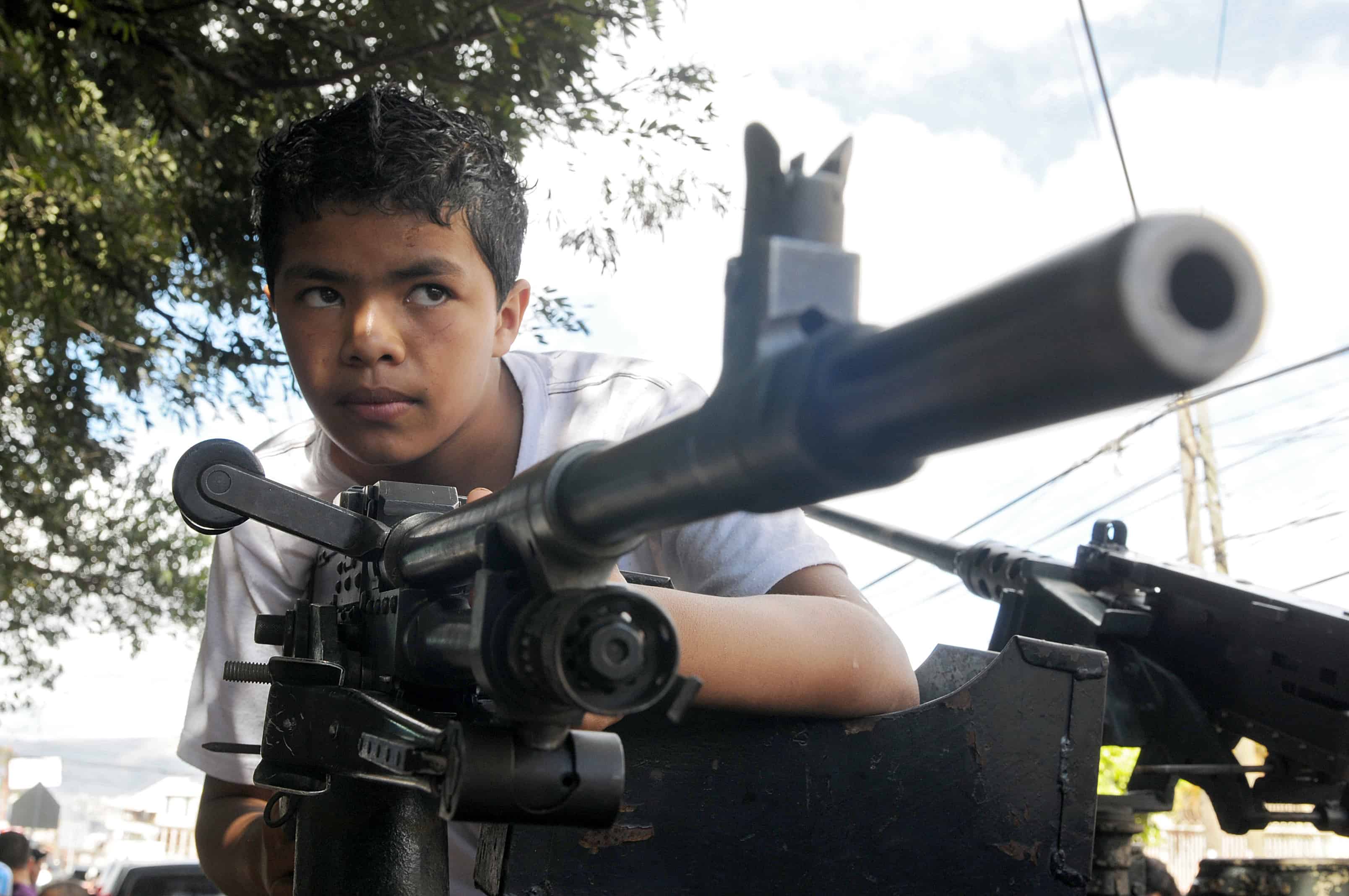
The Honduran military establishment says parents are not fulfilling their role in teaching children essential guiding values and principles.
Thus, the Honduran Armed Forces (FAH) – which during Cold War military regimes were called “Las Gloriosas Fuerzas Armadas,” or just “Las Gloriosas” – came up with a program called “Guardianes de la Patria,” or “Guardians of the Homeland.” The program targets kids aged 5-15.
Its target population is made up of some 25,000 children and teenagers in low-income, densely populated communities throughout the Central American nation, one of the countries in the region showing some of the most critical socio-economic figures.
Launched in March 2014, government and military authorities claim the initiative is not aimed at eventually drafting youngsters in situation of social vulnerability, but rather to keep them away from organized crime and maras, or youth gangs.
On the opposite side of the issue, human rights groups say the program violates the youngsters’ rights, and they’re demanding an end to it.
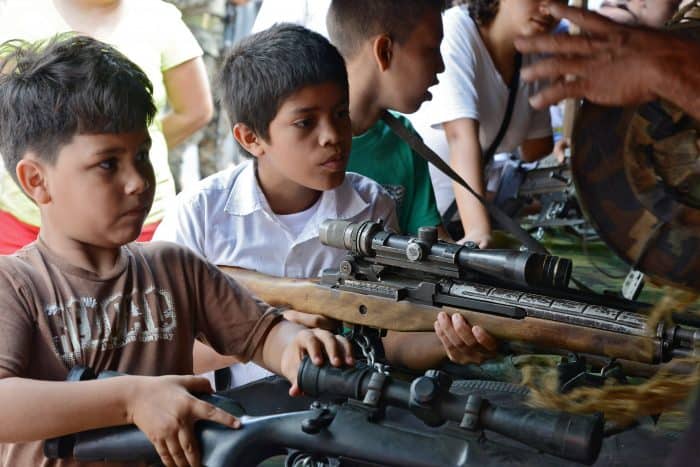
According to information posted by Honduras’ National Defense Secretariat (SDN), military units carry out eight-hour training sessions on Saturdays for minors living in nearby communities.
The program includes training by volunteer instructors, and it guarantees funds for children’s transportation to and from the units, educational materials, snacks and lunch, and security for each trainee.
The children “learn about conduct that will strengthen the next years of their lives, so that they make personal decisions based on moral behavior and ethical principles that ensure a better quality of youngsters in society,” the SDN says.
“Minors comply with the requirements of punctuality, permanent participation, and implementation of knowledge that develop them into Guardians of the Homeland,” the SDN’s website states.
Kids also acquire “knowledge and conduct with moral, ethical, spiritual and civic principles fostering in each one pride in the country,” it adds.
‘Civic and religious training’
Last year, Honduran President Juan Orlando Hernández launched the program during a ceremony held at the First Infantry Battalion’s Campo de Parada Marte in the town of Las Tapias, on the outskirts of Tegucigalpa.
“Today, we inaugurate … this prevention program’s first phase,” he said on March 29, 2014, adding that, “each Saturday, more than 25,000 children nationwide will receive civic and religious training that will allow them to develop a feeling of love for Honduras.”
Almost a month later, the head of plans, policies and programs at the Armed Forces Joint Chiefs of Staff, Col. Gustavo Adolfo Amador, stated that the program targets “specifically children at social risk and with no access to formal education.”
“The child’s interests are involved,” and “the beneficiaries are children practically living in city dumps, with no access to school and who have no parents to provide them with family and support.”
“They receive formal and non-formal education, such as workshops, lectures, Christian education, training in technical work, physical training, sports and recreation activities, according to age groups,” he explained, adding that there is a “school for fathers and mothers” as well.
Kids also “acquire knowledge of the Bible, Christian values and principles, respect for God’s places, and the importance of belonging to a church.”
Amador said that “most of the public” favors the initiative, and he stressed that “there is no use of weapons, which children don’t even see, because the area they go to is the [military installations’] social area.”
He added that, “there’s no teaching linked to military orientation.”
‘We’re not militarizing; we’re training’
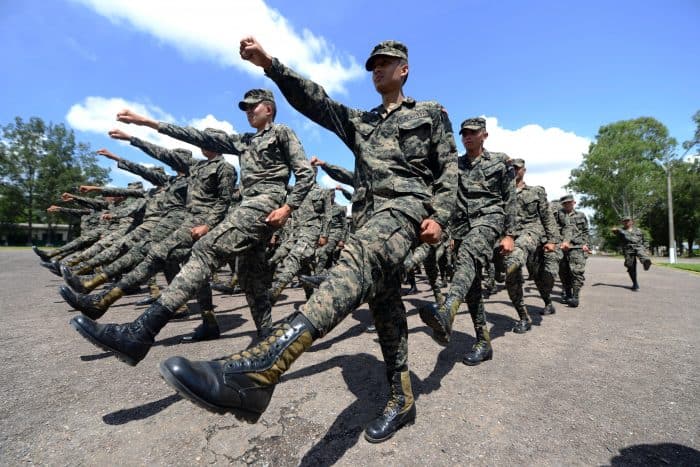
According to Armed Forces spokesman José Antonio Sánchez, “we’re neither militarizing nor drafting youngsters. We’re training them.”
Participants are at a “high risk” of falling into the hands of organized crime, he said.
In its May 16, 2014 issue, the Universidad Nacional Autónoma de Honduras’ newspaper, Presencia Universitaria, published an article titled, “World movement for childhood requests ‘Guardianes de la Patria’ program be revised.”
Immediately under the story’s title and byline, the paper carried a photograph showing military personnel supervising children carrying out a military-type exercise.
In the picture, two of the children crawl under a barbed wire structure a few inches above the ground, as other minors watch in the background.
Local media also have illustrated stories on the program, with photographs of children standing in military formation at FAH installations, accompanied by uniformed personnel.
In its article, Presencia Universitaria reported that, “the Movimiento Mundial por la Infancia de Latinoamérica y el Caribe [the World Movement for Childhood in Latin America and the Caribbean, MMI-LAC] called on the Honduran government to review the program.”
The MMI-LAC believes “new opportunities should be promoted for boys, girls and adolescents in situation of social risk,” the story noted.
On April 26, 2014, the Coordinadora de Instituciones Privadas Pro las Niñas, Niños, Adolescentes, Jóvenes y sus Derechos (Coiproden), a children’s rights advocacy group, warned that the program violates minors’ rights, and demanded the president end it.
In a press conference, the human rights NGO called on Hernández and the military to “immediately suspend the program.”
Coiproden also urged authorities “instead of investing resources in the Armed Forces for these purposes, to transfer the budget to state institutions whose mission it is to care for vulnerable children and teenagers in order to fulfill their technical and financial needs.”
Two days later on the televised debate show “Frente a Frente,” Coiproden Director Wilmer Vásquez said that, “with this program, attention is diverted that should be centered on institutions that have the real responsibility [to care for at-risk children] in this country.”
The military’s program “has a political backdrop,” charged Vásquez, who added that, “I believe they’ve failed in their strategy to attract youngsters into the military service.”
The initiative “exposes boys and girls to a culture of weapons that has a political-military aim,” he said.
See also: Is Honduras heading for the privatization of parts of its territory?





