
After nearly 14 years of living in Ticolandia, I have come to appreciate so many things about the Costa Rican culture, people, and way of life. While there are many gems to treasure, today’s topic will highlight something that anyone who lives here long enough will eventually encounter in first person: the culture of the Roadside Good Samaritan.
The concept is fairly simple. If you are driving a vehicle in Costa Rica and end up in some kind of distress, someone is definitely going to stop and see how they can help. The response time is nearly immediate, depending on how populated an area you are in, and there are often multiple Good Samaritans involved in the response.
The issues can range from fairly simple flat tires to an overheated engine to more complicated situations of getting stuck in deep mud, raging rivers, or even the ocean. Once, we were involved in a situation where an old man helped us out after a terrifying experience when our brakes failed while driving down a volcano. Let me give you a few more case studies to prove my theory.
I was a proud Kia Picanto owner for seven years. If you have ever seen a Kia Picanto, you know that it is basically the size of a large toaster and rides very low to the ground. While it was not exactly the perfect vehicle for our life in rural Guanacaste, with its terrible dirt roads, bath tub sized pot holes, and deep river crossings, it was affordable and got great gas mileage.
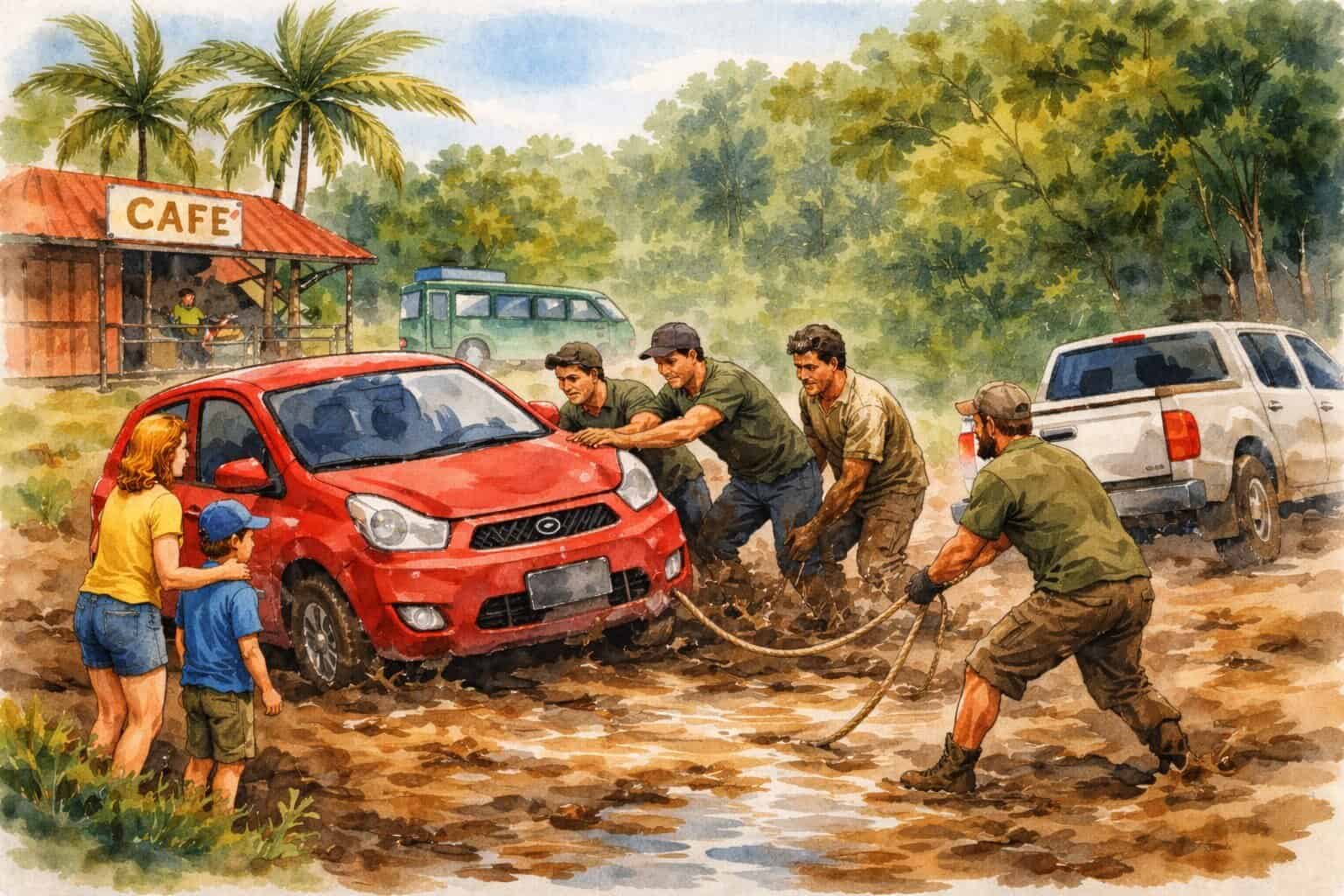
There were a few occasions over the years when the reality of driving in Guanacaste proved to be too much for the Picanto. On one such occasion, accompanied by my oldest son who was eight years old at the time, I drove into what I thought was a small puddle, which actually turned out to be an enormous hole. Within a matter of seconds, I realized I was completely stuck in the hole, which was also filled with thick, soupy mud.
Before I had time to panic, a crowd of people emerged from the neighboring café and bus stop. Several men used their pure brute force to push and lift the Picanto, while a kind woman stood with my son as I struggled to drive out of the crater. After spinning out my tires a bit and thoroughly covering at least one of my good Samaritans head to toe in mud, my little car was free.
We celebrated for about 30 seconds, and then everyone disappeared as quickly as they had arrived. I didn’t even have a chance to offer a wet wipe to mud guy. It was pure magic. Another time recently, I was on my way home from work with both of my boys in tow. It had just started to pour, and about five minutes from our house, I realized that a line of cars was starting to form as a result of a recently fallen tree.
I have had many encounters with trees falling down in the road over the years in Costa Rica. Sometimes they are mammoth trees that require chainsaws, but usually it is a case that can be dealt with swiftly by a group of a few men with machetes. We were dealing with the latter on this particular day. I was the third car in line, and I watched intently as a small group of men started out with the old tried-and-true pull the tree out of the road with a rope tied to a car maneuver. Unfortunately, this technique failed instantly as the rope snapped.
I then realized that I was breaking a golden rule of driving in Costa Rica. I had changed cars earlier in the year, finally upgrading to a 4×4 after having spent two weeks of the previous rainy season trapped in my house because the Picanto couldn’t make it through the completely in transitable road into town. After cleaning out the Picanto to sell it, my trunk machete ended up on my porch and never officially made it into the new car. While I am not exactly what you would call a machete expert, I would have gladly lent it to one of the rope guys.
But not to worry, another, more prepared guy shortly arrived on the scene with machete in hand. After a few strategic chops and some teamwork to get the bigger pieces out of the way, the road was clear, and we were all happily on our way. My husband Vincent recently got to serve as a Good Samaritan for an Italian couple who had misgauged the depth of a muddy hole on the dirt road shortcut to our house. The hole, much like my Picanto puddle, turned out to be much deeper than anticipated, and they were very stuck.
As a man with a pickup truck, the fates are going to align more frequently to give Vincent opportunities to participate in roadside assistance. Even after a long day of hiking and doing his biologist things, he stopped without hesitation to see how he could help and was soon joined by another roadside helper.
They went for the rope method, which also involved rocks, physical pushing by the couple, and coaching from the other helper, who guided him with a series of very specific and strategic Dele’s. This time the rope method worked like a charm, and the grateful couple insisted that Vincent come to their house for a celebratory beer. He respectfully declined but headed home with the dopamine high of another successful roadside rescue.
As I reflect on this concept, I think about how this type of situation usually works in the US. For starters, these situations arise way less frequently. The roads are paved and generally are in good condition. Cars tend to be a bit newer and nicer. And even when these situations do come up, a monetized service is usually the solution.
AAA is a paid rescue service for when you get a flat or need a tow truck. I am not sure that I have ever even seen a tree block a road around where I grew up, but surely it would involve a dozen fire trucks, twenty police cars, and at least one very expensive tree removal service.
But here things are different. Necessity requires an unspoken solidarity between drivers on Costa Rican roads. The unpredictable Mario Kartesque nature of driving on local roads, combined with the kind, helpful personalities of Ticos, creates the Roadside Good Samaritan culture.
As a lady driver on some pretty wild roads, I am deeply grateful for this culture and feel safer as I go about my day, knowing pretty confidently that the cavalry is eventually going to show up. And while I am probably not the most effective roadside Good Samaritan myself, next time I’ll be prepared to lend my machete.