
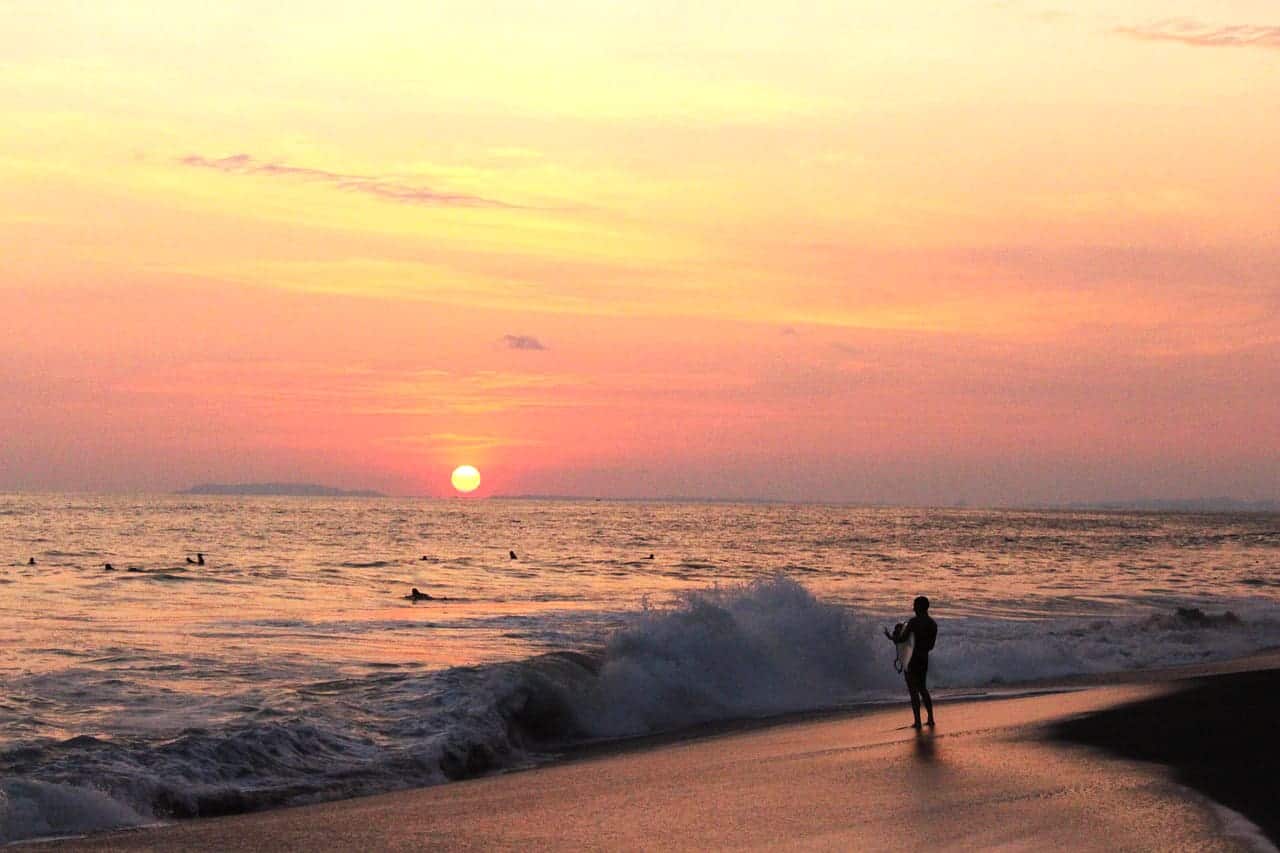
At the end of a street lined with luxury hotels, a dozen houses made of zinc and wood go unnoticed by tourists in the seaside resort of Jaco, Costa Rica. Both sides are bathed by the same sea, but not by the same luck. For three months, Americans, Canadians and Europeans have been filling the streets of this Pacific city, two years after a pandemic that hit tourism, the economic engine of this Central American country.
“On social networks, everywhere I heard that many people are coming here now. I was in the United States before and a lot of people come from there to Mexico and then to Costa Rica and that’s why I wanted to explore,” says German tourist Jessica Friesen, 27, before entering the sea.
Jacó has optimal waves for surfing and orange sunsets perfect for Instagram. Some visitors prefer to ride on the sand. A mountain range inhabited by monkeys and macaws surrounds the city, while the Tárcoles River crocodiles travel comfortably.
Although it is one of the cities with the highest human development index in Costa Rica, prosperity does not reach everyone in this country where 23% of its 5 million inhabitants are poor. A dilemma that will have to be solved by whoever is elected president in the ballot on April 3.
Reviving the Costa Rica Cemetery
Eliecer Morales is 82 years old and is one of the first inhabitants of Jacó, a city created in 1965. He participated in the construction and growth of the resort, including luxury beach hotels that are its neighbors. “Jacó was about four little houses. And now to see it as it is, it’s nice. But life becomes more difficult. For those who are poor like me, who live in the shadows, with my little pension and the fishing I do,” he says.
After suffering an accident and losing his job, he could no longer afford to pay rent. 22 years ago he asked the municipality for permission and settled on the land of the old cemetery of Jacó, in a swampy area surrounded by mangroves, and built his house with zinc sheets, among crosses and tombstones.
“You have to be more afraid of the living than the dead,” he says. One of her children, who died at the age of 3, was already buried there. The constant flooding of the Quebrada Bonita river, which flows into the Pacific, almost at the door of his house, has carried away several graves.Eliecer planted banana and avocado trees. His wife, six of his eight children and his grandchildren are settled there. There are 35 people.
He survives on fishing, selling part of his catch to tourists, and on a pension equivalent to 200 dollars. He is used to his routine and does not want to leave the place, which has electricity. His children have different jobs in town and that, he says, gives him peace of mind.
But he hopes that a new government will improve housing for the population, including his own. “This [president] who is leaving did nothing (…) Whoever comes, let him help the poor more, a little house, what we need most,” she says.
Housing in Costa Rica
Jacó is located in the canton of Garabito, whose mayor is Tobías Murillo. He managed to keep the beaches open for local tourism despite the pandemic, so that the economy of his town did not collapse.He says that the economic problems are not due to lack of work, but because Jacó has become an expensive resort.
“There are people who work in banks, state entities, big hotels. The problem is that Jacó is expensive” and their money is not enough for rent, says Murillo.The mayor believes that the new government should eliminate the bureaucratic obstacles for social housing.
Costa Rica and Stability
Jeniffer Hascall is American and owner for seven years, together with her husband, of Croc’s Hotel and Casino, the most luxurious in Jacó. The pandemic forced her to reduce her staff from 280 to 105 workers. Their supplies, from fruits to fish, they try to buy them from local suppliers. They hope that everything will soon “return to normal” and that there will be more investment.
“Costa Rica is one of the most stable countries in Central America. I think foreign investors are comfortable placing their money here,” explains Hascall. Eliecer says that the hotels next to his house “are good neighbors” and that the more tourism there is, the better for the town.
He hopes, rather, that it will be the new government that cares about the poor. “I wish there was a good president who would help everyone. Costa Rica needs help,” he says.
by Moises AVILA