
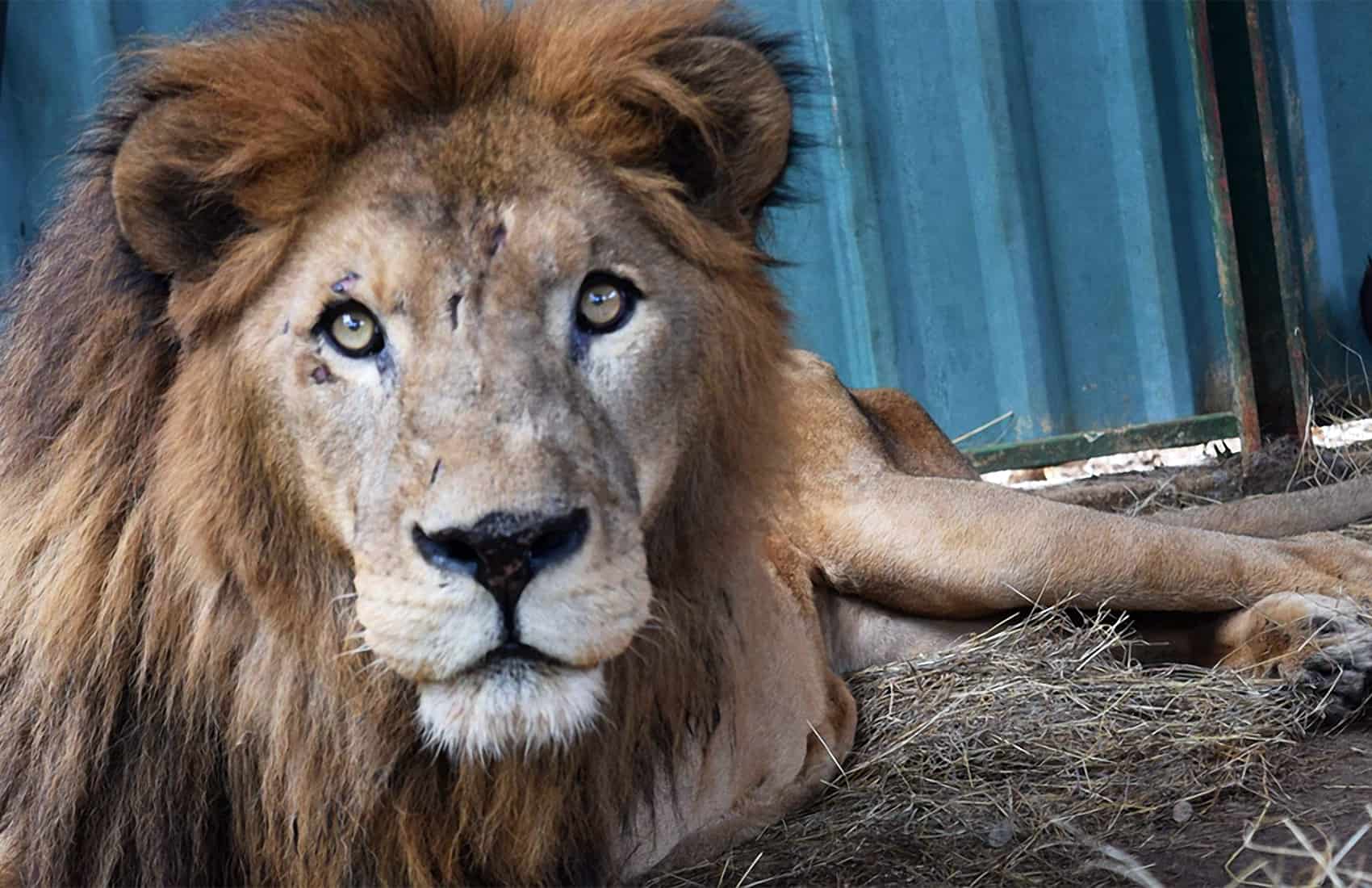
Environment Ministry (MINAE) officials are closely monitoring the health of Kivú, the only living lion in Costa Rica, after several days when he refused to eat or drink.
On Monday, Environment Vice Minister Patricia Madrigal said in a news release that the 17-year-old feline’s condition has improved, and that he has started eating and drinking water again. She also said that the lion was responding positively to medication applied over the weekend.
According to the Ministry, laboratory tests conducted upon the lion’s arrival at his new home in ZooAve last month showed symptoms of chronic kidney disease, prompting officials to send the results for further evaluation to a laboratory in the United States.
The statement went on to say that Carlos Sánchez, a wildlife veterinarian from Fort Worth Zoo with a vast experience in geriatric cats, is also providing assistance with Kivú’s treatment.
MINAE reported that the lion is being monitored around the clock with the help of three cameras and that he is receiving all necessary medical attention.
Madrigal said a team of experts from the ministry and from the National Animal Health Service have been following the lion’s evolution since his arrival last month at his new home at ZooAve, a private refuge in the province of Alajuela.
The lion’s new home is a 300-square-meter (some 3,300 square feet) area surrounded by nature, with plants, ramps, a pond, a cave and other spaces where he can hide if he wants to. He is no longer on public display, a change that was made to avoid any stress for the animal.
MINAE and other government officials relocated the lion in December from his old home at a cage at the Simón Bolívar Zoo in San José to provide him with better living conditions.
Kidney disease
Randall Arguedas, a vet with FUNDAZOO, the administrator of Simón Bolívar Zoo, said in a statement that Kivú did not show any signs of kidney disease when zoo officials tested him last May.
Arguedas said that before MINAE officials, “arbitrarily and using force, seized the lion on Dec. 5,” the lion had made a 90 percent recovery after undergoing medical treatment for severe weight loss.
“He was eating all of his food, as well as vitamins and nutritional supplements; he was active and showing normal behavior,” he argued.
Arguedas said that chronic kidney disease is common in geriatric felines and that it gets worse when they stop drinking water and begin to dehydrate. The zoo vet blamed MINAE officials who “ignored all recommendations issued by FUNDAZOO” to maintain the lion at the zoo.
He said MINAE leaders knew that moving the lion from downtown San José to Santa Ana, and therefore to an environment with a different temperature, relative humidity and luminosity than the conditions Kivú was used to, would cause stress for the lion and undo the progress his caretakers had achieved in his health.
Relocation orders
Officials of MINAE and the Agriculture and Livestock Ministry conducted the relocation of Kivú on Dec. 5, arguing that FUNDAZOO had failed to comply with orders to move the lion to a better space.
Evaluations from both ministries in September concluded that the zoo cage where Kivú was been exhibited was unsuitable for the old feline. Kivú arrived at the zoo in 1999 and had already exceeded the average of 14 years that captive lions usually live.
MINAE ordered the zoo administrator to relocate the lion to a better location at an animal shelter west of San José within two months. FUNDAZOO officials failed to comply with the relocation orders by the deadline, and insisted they had a plan to build a new enclosure within the capital’s zoo.
The fate of Kivú has been a matter of public interest for years, with some Costa Ricans denouncing the lion’s condition and his evident weight loss during his last months at the zoo.